About Us
Embarrassing personal details
About The Band
The Plastic Bastards have been making something that loosely resembles music since the late 1980s.
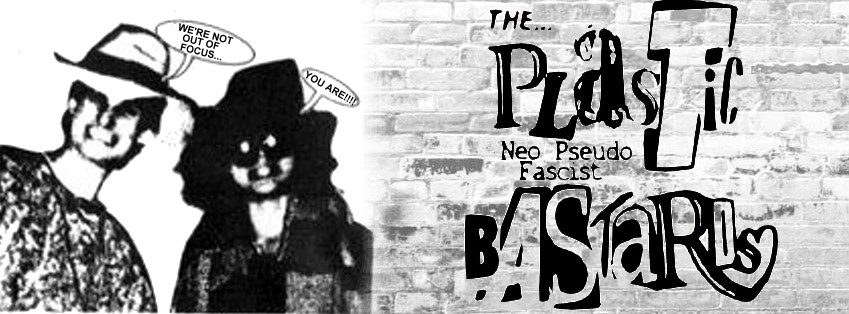
Originally called “The Plastic Neo Pseudo Fascist Bastards”, a considerably less marketable (yet somehow more fun) name, the band shortened it after discovering that some people were remarkably capable of missing the joke. What remained was The Plastic Bastards: part band, part comedy act, part multimedia experiment, and several parts bad judgment.
At the center of the group are Will Wonkers (Patrick Burns) and Ned Nugent (Eugene Chiovari), the former being musician, singer and songwriter and the latter being singer, songwriter and sound engineer. Rather than playing conventional rock-star alter egos, the Bastards created exaggeratedly stupid versions of themselves, characters seemingly mentally trapped at about fourteen years old, regardless of how many decades pass around them. The resulting songs can be juvenile, obscene, absurd, satirical, political or just idiotic (sometimes deliberately), often without bothering to choose only one.
Musically, The Plastic Bastards have never fit particularly comfortably into a single category. Punk attitude, bubblegum hooks, alternative rock, comedy music, outsider music and whatever happened to be lying around at the time have all found their way into the sound. The band’s own description has always been considerably more efficient: crap that rhymes.
By 1990, the Bastards had also developed an unusually ambitious live show built around interactive prerecorded video. This wasn’t simply footage projected behind a band. Video became another performer. Prerecorded versions of the Bastards traded dialogue with their live counterparts, supplied backing vocals and participated in carefully timed jokes and routines, requiring the musicians onstage to remain synchronized with a continuously running video production. Created in the decidedly pre-digital world of Super VHS and U-matic editing, the show anticipated the kind of integrated live/video spectacle that would become much more visible in major concert productions during the years that followed.
Not every club could accommodate it. Venues needed enough room for the large projection screen and the equipment required to make the whole ridiculous contraption work. Where it could be staged properly, however, a Plastic Bastards show wasn’t simply a concert with video playing behind it. The live performers and the people on the screen were performing the show together.
The songs themselves have followed much the same philosophy. Nothing is automatically too stupid, tasteless, strange or inappropriate to become a Plastic Bastards song. Sometimes the joke is political satire. Sometimes it’s social commentary. Sometimes it’s a spectacularly immature joke stretched much farther than any responsible adult would permit. And sometimes the entire point is that there isn’t a point.
More than three decades later, The Plastic Bastards technically remain active, although new material emerges whenever the Bastards damn well feel like making it. Old recordings, unfinished songs and ideas that probably should have been abandoned years ago continue to find their way back into circulation alongside newer material.
Trends have changed. Technology has changed. The music industry has changed almost beyond recognition.
The Plastic Bastards have demonstrated considerably less personal growth.