
How a $570 Box Democratized Recording and Helped Make the 80s/90s Indie Expansion Possible
There’s a version of music history most everyone knows, where a record only exists because someone with money agreed to pay for it. A label fronts studio time. An engineer runs the board. A band without that backing simply doesn’t get heard, no matter how good the songs are. For most of recorded music history, that was just how it worked.
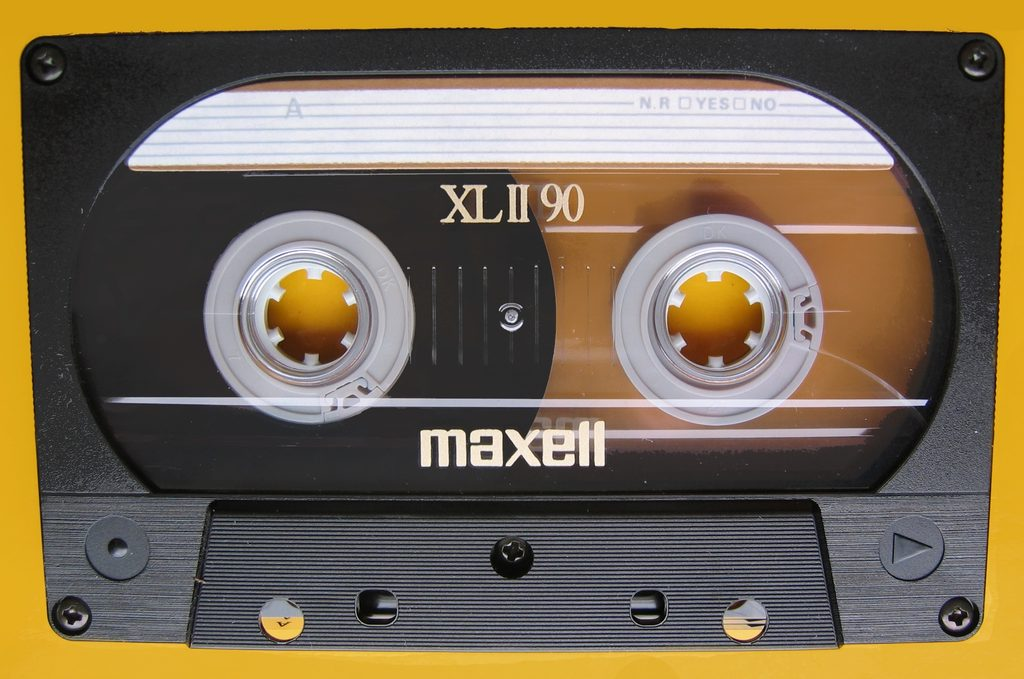
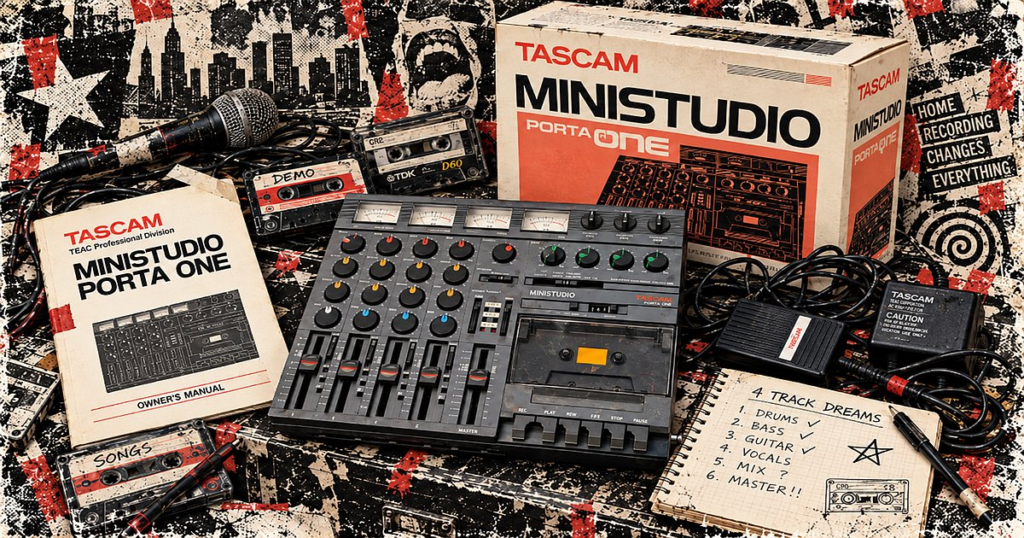
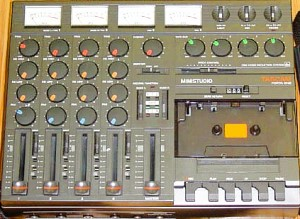
In 1984, Tascam (opens in a new tab) released a little miracle box about the size of an oversized hardcover book that broke that rule. It was called the Tascam Porta One (opens in a new tab). Battery or AC powered, under seven pounds in weight, it ran standard cassette tape (opens in a new tab) as well as chrome-equivalent cassette tape (opens in a new tab), like Maxell UD XL IIS (opens in a new tab), and packed a four-channel mixer with switchable dbx noise reduction (opens in a new tab) into a case you could sling over your shoulder and carry anywhere.
It cost £429 in the UK, roughly $570 in U.S. dollars at that year’s exchange rate (opens in a new tab), about $1,835 today (opens in a new tab). Real money, but a fraction of studio time, and you only paid it once. After that, nothing stood between you and a finished record except you.
We used one. The Plastic Bastards (opens in a new tab) tracked on a Tascam Porta One, and it’s a real example of, and part of why, bands with no label, no manager, and no budget still walked away with something on tape.
What the Tascam Porta One actually did
Four mono tracks on a standard or chrome-equivalent cassette. A built-in mixer (opens in a new tab) to set levels and EQ (opens in a new tab) while recording, bounce tracks together, and blend everything into a final mix. A maximum of two tracks could record at once while being able to monitor the other two, all four played back together, and you could use a bounce-and-combine trick called ping-ponging (opens in a new tab) which lets you stack more material onto those four tracks than the number four suggests.
It weighed next to nothing, needed no outlet, and went wherever the band went. Not a studio or room set aside for recording. Just wherever you happened to be, with your gear and your friends and something to play about.
The Tascam Porta One also had a pitch control (opens in a new tab) dial, letting you push tape speed up to 15% faster or slower than its standard 1⅞ ips (opens in a new tab). That dial was there to match pitch when working with outside material, but it had a second use: if you tracked an entire session at the faster setting from the start, everything stayed in the pitch you recorded it in, since speed only shifts pitch when record and playback speeds don’t match (although doing this deliberately leads to some very cool and experimental sounds).
What you got instead was a quality bump. The faster that tape moves, the more physical real estate on that tape gets devoted to every second of sound, which spreads the noise floor thinner against the music and sharpens the high end, the same reason professional studios ran their reel-to-reel decks at 15 or 30 ips (opens in a new tab) instead of consumer speeds. On the Porta One that 15% bump wasn’t going to touch studio-grade tape, but for anyone who knew to reach for it, it bought a real, audible edge in clarity and less hiss (opens in a new tab).
With this in your hands, you did not need permission. You did not need someone else’s schedule, someone else’s room, or someone else’s money. You needed the machine, and then the rest was up to you.
Nobody had done this before, not really, well, not exactly
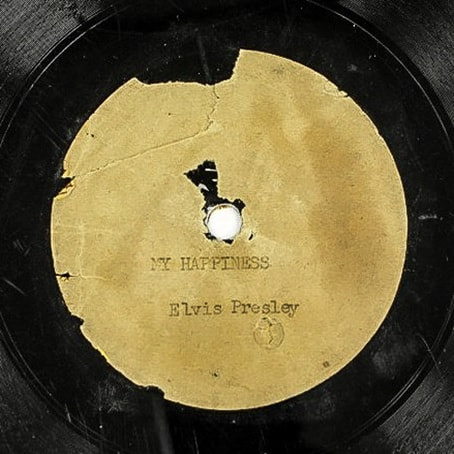
Cheap recording already existed, and had for decades. In 1953, an eighteen-year-old Elvis Presley (opens in a new tab) paid about four dollars (opens in a new tab) at Memphis Recording Service to cut a one-take acetate of himself singing.
Long before that and for decades after, coin-operated Voice-O-Graph (opens in a new tab) booths (opens in a new tab) (okay, can we take a moment and revel in just exactly how fucking retro cool this tech is) sat in arcades, boardwalks, and fairgrounds, lathe-cutting (opens in a new tab) a live disc for a quarter while you sang into a microphone.
Both got you one live take, straight to disc. No overdubbing a second part. No mixing. No fixing anything without starting over new.
Home multitrack recording wasn’t entirely new either. Tom Scholz (opens in a new tab) built his own four-track reel-to-reel machine from scratch (opens in a new tab) in a Massachusetts basement in the early 1970s and used it to record most of Boston (opens in a new tab)‘s seventeen-million-selling debut (opens in a new tab). But Scholz was an MIT (opens in a new tab)-trained engineer with the skill to design and build his own recording gear because he couldn’t afford to buy any. That path wasn’t open to most people.
What the Tascam Porta One did was take the actual thing, real multitrack production, overdubs, mixing, a finished song built in layers, and put it on a shelf for a few hundred dollars, with no engineering degree and no custom-built hardware required.
What it helped make possible
By the mid-80s, a lot of bands were finding their way to some version of this idea, though not always on this exact machine. Beat Happening (opens in a new tab) and the K Records (opens in a new tab) crowd out of Olympia built a whole label around cheap home recording, on Portastudio-family gear more broadly rather than this exact model. Beck (opens in a new tab)‘s earliest four-track work came from the same instinct, on a machine that’s gone unnamed in the history.
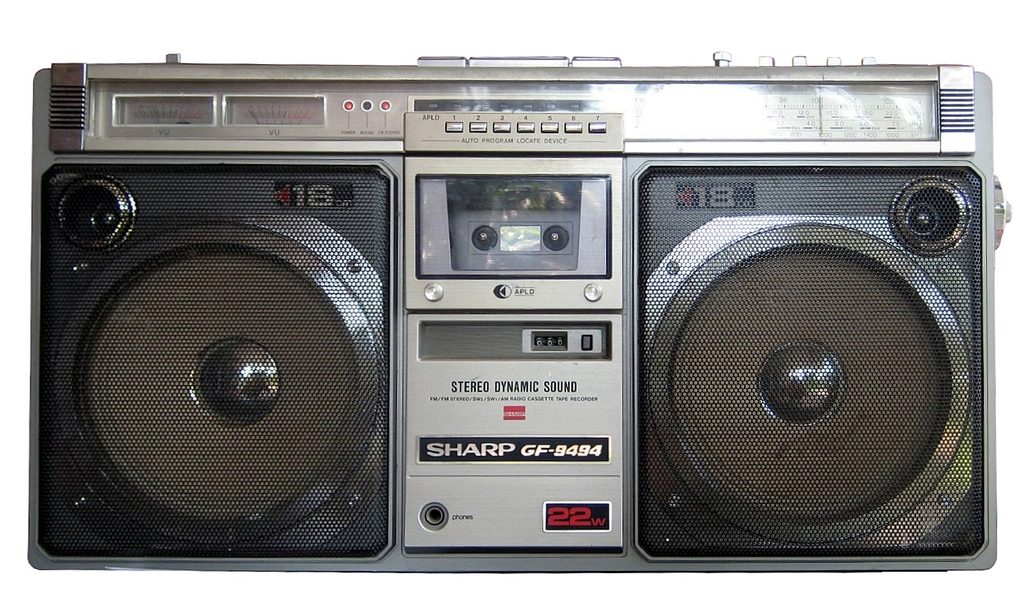
Daniel Johnston (opens in a new tab) went even further down-market, recording much of his most famous early material straight onto a cheap boombox (opens in a new tab), no mixer at all. Elliott Smith (opens in a new tab) taught himself on a borrowed four-track before eventually working up to eight tracks. None of them were necessarily on a Porta One specifically. All of them were proof of the same underlying shift: cheap machines were putting real production into the hands of real people who now had real options.
The Porta One itself has a more specific paper trail. Guided By Voices (opens in a new tab) is widely reported to have recorded much of its early catalog, ten albums’ worth of material along with singles and EPs, on guitarist Tobin Sprout (opens in a new tab)‘s Porta One, with vocals cut in his basement and full-band parts taped in drummer Kevin Fennell (opens in a new tab)‘s garage.
It wasn’t a one-off session. For years, it was their actual studio, run out of houses in Dayton, Ohio. Lou Barlow (opens in a new tab) started Sebadoh (opens in a new tab) on a four-track, reportedly a Porta One like GBV’s, for the same reason GBV kept using theirs: it was the only studio he could afford, and it turned out to be the only one he needed.
Labels grew up around exactly this kind of material. Scat Records (opens in a new tab), the small Ohio label that put out GBV’s Bee Thousand (opens in a new tab), and Homestead Records (opens in a new tab) before it, existed because there was suddenly a steady supply of finished, home-made records worth releasing, something that simply couldn’t have happened at this volume a decade earlier. The same thing happened on the cassette side: a distribution catalog called Cause and Effect (opens in a new tab) started in late 1984 listing over a hundred independently made cassettes, and within about a year it had turned into a label of its own.
The Plastic Bastards were part of that same wave, on that exact model machine, making the record because nobody else was going to make it for us. And we made our own label, with blackjack, and hookers (opens in a new tab), called Mr. Whadaphukinhel Records.
A word on “lo-fi”
It’s a phrase that gets thrown around carelessly, and it’s easy to hear it as a put-down. It shouldn’t be. “Lo-fi (opens in a new tab)” is a vibe comparison to professional studio multitrack, not a verdict on quality. There are real limits a cassette four-track has stacked up against twenty-four tracks of two-inch tape: less frequency range, more hiss even with noise reduction, and a compressed, saturated character. That’s genuinely part of the sound. It isn’t the same thing as bad, and the Porta One’s noise reduction and proper mixer were, for the money, a real engineering achievement.
By the late 80s, plenty of these artists could have afforded a studio but chose the four-track anyway, because that saturated sound had become the sound they wanted, not a limitation they were stuck with. It was the vibe. So the word does two jobs: it names a fidelity tier, and it names a genre of people who picked that tier on purpose.
We don’t use the porta one any more as we live in different parts of the country, we use a DAW and exchange takes remotely. But what we do do is we deliberately eq our mics and imputs to sound and respond like the porta one and the inexpensive ungrounded microphons we used to use. Also we have sampled extensive sections of blank tape space from our tascam four track masters and use this as background noise in all our modern digital recording.
In summary
A company built an affordable miracle box that changed who got to make an album. It did not care about your budget or who you knew or who you had to kiss up to. All it needed was someone with something to say and a few hundred dollars saved up. It’s why a band nobody had heard of in Dayton, Ohio, or a band nobody had heard of anywhere else, could make something real, on their own terms, in their own space, who got to press play on their own future. And that’s the shift. For decades, making a real record meant walking through someone else’s door first. The Porta One took that door away. It didn’t hand anyone success, but it handed them the tools to forge it on their own.
Sources
Tascam’s Porta-1 (In Tune, Dec 1984) – muzines.co.uk (opens in a new tab)
$1 in 1984 → 2026 inflation calculator – in2013dollars.com (opens in a new tab)
List of songs recorded by Elvis Presley on the Sun label – Wikipedia (opens in a new tab)
Voice-O-Graph (1940s–1960s) – Obsolete Media Archive (opens in a new tab)
A Voice-O-Graph Blast from the Past – Mix Magazine (opens in a new tab)
He was an MIT grad with dreams of stardom – The Boston Globe (opens in a new tab)
Scholz Research & Development, Inc. – Wikipedia (opens in a new tab)
Tom Scholz – Wikipedia (opens in a new tab)
Boston (band) – Wikipedia (opens in a new tab)
Boston (album) – Wikipedia (opens in a new tab)
Beat Happening – Wikipedia (opens in a new tab)
K Records – Wikipedia (opens in a new tab)
Beck – Wikipedia (opens in a new tab)
Daniel Johnston – Wikipedia (opens in a new tab)
Elliott Smith – Wikipedia (opens in a new tab)
Guided by Voices – Wikipedia (opens in a new tab)
Tobin Sprout – Wikipedia (opens in a new tab)
Tascam Porta One – Artist Usage – Equipboard (opens in a new tab)
Sebadoh – Wikipedia (opens in a new tab)
Lou Barlow – Wikipedia (opens in a new tab)
Bee Thousand – Wikipedia (opens in a new tab)
Scat Records – Wikipedia (opens in a new tab)
Homestead Records – Wikipedia (opens in a new tab)
Lo-fi music – Wikipedia (opens in a new tab)
The Plastic Bastards – plasticbastards.com (opens in a new tab)
Ping-pong recording, Wikipedia – https://en.wikipedia.org/wiki/Ping-pong_recording (opens in a new tab)
Mixing console, Wikipedia – https://en.wikipedia.org/wiki/Mixing_console (opens in a new tab)
Equalization (audio), Wikipedia – https://en.wikipedia.org/wiki/Equalization_(audio) (opens in a new tab)
Audio tape specifications, Wikipedia – https://en.wikipedia.org/wiki/Audio_tape_specifications (opens in a new tab)
Why 15 IPS Analog Recording Delivers Superior Sound – https://www.thejazzbureau.co.uk/post/why-15-ips-analog-recording-delivers-superior-sound (opens in a new tab)
Learn The Key Differences Between Analog Tape Speeds, Performer Mag – https://performermag.com/home-recording/learn-the-key-differences-among-analog-tape-speeds/ (opens in a new tab)
Tascam, Wikipedia – https://en.wikipedia.org/wiki/TASCAM (opens in a new tab)
Cassette tape, Wikipedia – https://en.wikipedia.org/wiki/Cassette_tape (opens in a new tab)
Compact Cassette tape types and formulations, Wikipedia – https://en.wikipedia.org/wiki/Compact_Cassette_tape_types_and_formulations (opens in a new tab)
Maxell, Wikipedia – https://en.wikipedia.org/wiki/Maxell (opens in a new tab)
dbx (noise reduction), Wikipedia – https://en.wikipedia.org/wiki/Dbx_(noise_reduction) (opens in a new tab)
Pitch control, Wikipedia – https://en.wikipedia.org/wiki/Pitch_control (opens in a new tab)
Disc cutting lathe, Wikipedia – https://en.wikipedia.org/wiki/Disc_cutting_lathe (opens in a new tab)
Massachusetts Institute of Technology, Wikipedia – https://en.wikipedia.org/wiki/Massachusetts_Institute_of_Technology (opens in a new tab)
Boombox, Wikipedia – https://en.wikipedia.org/wiki/Boombox (opens in a new tab)
Kevin Fennell, Wikipedia – https://en.wikipedia.org/wiki/Kevin_Fennell (opens in a new tab)